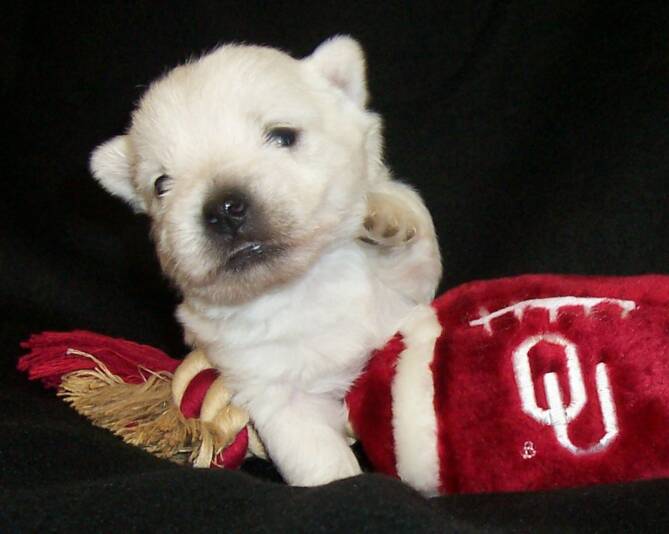
On this page, you will find information about caring for your new puppy. For instance, please scroll down to read what items will come with your puppy, what items to have on hand when your puppy arrives, feeding instructions, bathing instructions, how to make a "rice puppy" which will cause your puppy to feel safe and secure in his or her new home, house training tips, and a supply list for home grooming.
Please note, I periodically add information to this page. As a result, if you know of some excellent information which should be added to this page, please let me know. I am always looking to improve my website and all information contained within my website. Thank you very much.
Items Which Will Come with Your Puppy
1.A Veterinarian-Signed Health Certificate
2.A Signed One-Year Health Guarantee
3.AKC Papers (Your puppy will already be completely registered with AKC. His or her ownership will be completed in your name.)
4.Shot/Worming Record
5. AKC Reunite Microchip Pamphlet and Information
(You will receive a lifetime membership to AKC Reunite which is a nonprofit pet recovery service dedicated to reuniting lost and stolen pets with their families. Also, to ensure integrity, your puppy's microchip number will be on the health certificate, health guarantee, AKC papers, and the shot/worming record. Basically, this ensures that my vet did indeed see and examine your puppy, and it ensures that all paperwork belongs to your puppy and your puppy only. One last note, your AKC Reunite collar id tag will arrive through the mail shortly after your puppy arrives. It will arrive in a plain white envelope, and it will have the AKC Reunite's logo in the upper left hand side of the envelope. Be careful not to throw it away. It looks a bit like junk mail.)
6. AKC GoodDog! Brochure and Information
(You will receive a lifetime membership to AKC GoodDog! which is a helpline of qualified dog trainers just waiting to assist you with your training needs.)
7.Feeding Instructions
8.Housetraining Tips
9. Brochures/Pamphlets on Miscellaneous Health and Safety Tips
10.Your Puppy's Parents' Pedigrees
11. A one year subscription to AKC Family Dog magazine
12. If your puppy is to be shipped, he or she will arrive in an airport-approved puppy crate which can also be used for housetraining and car rides.
Housetraining Tips
For house training, I combine the wee-pad method and the crate method.
Crate Method
When using the crate method, the crate should mock a dog’s den which is the puppy’s natural environment in the wild. It should be large enough that the puppy can stand up and turn around; yet, it should be small enough that the puppy will not be able to sleep on one side of the crate and use the bathroom on the other side of the crate. If it's too big, the puppy will both sleep and use the bathroom in it. Also, some people will drape a sheet over their puppy’s crate to add to the feeling of a den/cave-like environment. However, if you do this, please make sure that the puppy can get fresh air into the crate; otherwise, it could smother. The ventilation holes on the crate are very important and very necessary.
This paragraph will outline how to use the crate method. For the crate method, you are suppose to take the puppy outside to use the bathroom before putting the puppy into its crate. This is the MOST important part of the method. If the puppy has not gone to the bathroom prior to being put into the crate, it will be very uncomfortable in the crate because it will probably need to go to the bathroom. You want the puppy to feel safe and secure while in the crate, and the crate should be the puppy’s bed. No one likes to go to sleep when they need to use the bathroom. After being in the crate for a few hours, you are suppose to take the puppy outside immediately to use the bathroom. It is no different than when people wake up–the first place we go is the bathroom. Then after using the bathroom, you can offer the puppy food and water. Then, you take it back outside to use the bathroom because eating or drinking usually causes the puppy to need to use the bathroom again. Once the puppy has used the bathroom again, you can safely play with it indoors. After play time is over, the puppy should go back outside to the bathroom, and finally, it should go back into its crate for a couple more hours. Basically, a puppy needs to go to the bathroom frequently because its bladder is just so tiny, and the typical times that a puppy needs to use the bathroom is after waking up, after eating/drinking, and after playing. I hope this helps. If it doesn’t, please call me at (405) 379-9988 or e-mail me at tamnspuppies@yahoo.com
Wee-pad Method
When using the wee-pad method, the idea is to confine the puppy to a small area by using something like an exercise pen. On one end of the exercise pen, you will put the puppy’s food, water, and bedding. On the other end of the pen, you will put a scented wee-pad. The wee-pad will draw the puppy’s attention by its scent, and the puppy should relieve itself on the wee-pad instead of any other areas in the exercise pen. Then you simply dispose of the wee-pad once it is soiled. Please note, sometimes, puppies think that the weepad is a toy, and they want to shred it. As a result, if you purchase a weepad tray to put the weepad inside, it will keep them from doing this.
Combination Method
When I worked outside of my home, I combined the two methods. If it was a weekend or an evening, I would use the crate method because I was home to take the puppy outside every few hours, and honestly, this is the best method for quick results and long-lasting results. However, while at work or if I really needed to sleep all night long and the puppy would not sleep, I used an exercise pen which had the puppy’s food, water, and bedding on one end and the wee-pad on the other end. However, as soon as I woke up, I would take the puppy outside just like I would have with the crate method, and I also would still take the puppy outside after eating, drinking, before playing, and before going back into the exercise pen.
In addition, when I played with the puppy inside my home, I always had a wee-pad in the room. If the puppy needed to go, the wee-pad would be used instead of the carpet. Also, I would play with the puppy in the room which had the outside door. Slowly, I would move the wee-pad closer and closer to the front door. Within a week or so, the wee-pad would be positioned right in front of the door, and by doing so, the puppy would automatically be trained to go to the door when it needed to go to the bathroom. As a result, when I saw the puppy going to the wee-pad, I would praise him, and I take him outside to relieve himself. Combining the methods works very well, especially for working people.
Bathing Instructions
Westies have an exceptional coat, a wiry coat, which is naturally equipped to repel moisture and dirt. Now, this does not mean that they will not get wet or dirty. They will of course. However, their coat is designed to repel most of the moisture and dirt that they come in contact with. This is very beneficial to us pet owners because it means that our Westies are much less likely to exhibit doggy odor than other breeds. Doggy odor typically results from a coat which absorbs moisture and dirt instead of repelling it. With this being said, it is important to not overbathe your Westie because overbathing will cause your pet's coat to lose some of its ability to naturally repel moisture and dirt. Overbathing will soften the coat and cause it to lose its natural repelling ability. Also, overbathing can lead to skin irritations if you do not adequately rinse the coat. Leaving shampoo, conditioner, or a rinse in your puppy's coat can cause an itchy response so please be sure to rinse thoroughly.
As a general rule, I recommend bathing your puppy once a month unless, of course, the puppy gets into something really yucky. In between baths, you can simply wash their feet or any other body part with clear water. Also, brushing their coat will cause most of the dirt to come out because the dirt is typically on the outside of the hair, not the inside, since the coat naturally repels dirt.
As mentioned above, I use Bio-Groom Super White as a whitening shampoo, and I use HealthGuard when they get into something yucky. HealthGuard is an anti-bacterial, anti-fungal shampoo; yet, it is gentle and non-abrasive so it's excellent for puppies. It's also excellent after vet visits, times at a doggy park, or any other time that puppy might come in contact with germs or bacteria from other dogs. However, as long as your puppy's shots are up-to-date, please do not be afraid to take your puppy in public. I want you to enjoy your puppy and enjoy taking him or her to special, fun places. This shampoo is simply a HealthGuard as its name states. It is simply extra protection. Also, please remember not to overbathe your puppy. That can do more harm than good. Westies are a very hardy, healthy breeds. You should not have any problems. Simply enjoy your puppy, and if he or she was exposed to something that seems questionable, give him a bath in HealthGuard. Also, most germs are transmitted on the feet so bathing the feet is frequently all that's necessary. However, always be sure to thoroughly rinse if you are using shampoo. Rinsing is very important.
Again, I hope that this information was helpful and not overwhelming. I am giving you way more information than you need, but I am simply a very thorough person. Also, if you have any questions, please do not hesitate to ask. Thank you.
Feeding Instructions
I feed my dogs and puppies Diamond Pet Food Naturals for Small Breed Puppy. I chose this food because it has all of the necessary vitamins, minerals, antioxidants, and fatty acids needed for proper growth and development of a Westie puppy. Plus, it's an all-natural food which is rich in probiotics, and it's corn and wheat free. Many Westie breeders and veterinarians believe that some Westies are prone to corn allergies so feeding a corn free diet is recommended. Also, please note that corn is simply a cheap filler which dog food companies use to produce bulk or "stretch" their product. Corn has very little to no nutritional value for a dog or a puppy. It's merely an inexpensive way to stretch a dog food causing dog food companies to produce more food for less money. Really, it's no different than a person adding crackers or bread crumbs to hamburger meat to stretch it. It's a money saving tactic. Likewise, since corn is simply a filler, it becomes a waste product which causes your puppy to have more stools. Simply put, a meat intense dog food will better nourish your puppy, and it will produce less waste and fewer stools.
I want to clearly and plainly state that I never had any food allergies or skin problems with my old bloodlines, and I worked with them for twelve years. Also, they did have some corn in their diets before I switched to Diamond Pet Food Naturals for Small Breed Puppy. As a result, I do not believe that my old bloodlines are prone to allergies because they never exhibited any signs of allergies, and my vet could verify this information. Allergies tend to run in certain bloodlines, and I am quite confident that my old bloodlines are free of allergies. However, at the same time, I believe that it is only wisdom to feed the best recommended diet for the breed. That is why I choose to feed a corn free diet.
Also, my new bloodlines have not shown any signs of allergies either so I believe that they are not prone to allergies as well. However, I want to let you know that Zita did tell me that Micko had a few bumps come up on his skin on two separate occasions. She also told me that she fully believed that it was due to grooming, and after she bathed him, it immediately went away. However, just to play it safe, I have been giving Micko a 225 mg tablet of kelp twice daily. According to Westies from Head to Toeby Ruth Faherty, the best skin supplement that you can give a Westie is a 150 mg tablet of kelp twice daily. I, however, could not find the 150 mg dose in my health food store so I went with the 225 mg dose. Also, I do not know if the kelp has helped Micko or if his past issue was nothing more than the need to take a bath. However, it was probably just a grooming issue. Zita is a professional groomer so she knows a lot more in that area than I do, and I trust her opinion. She keeps her dogs very nice, but during the winter they need a longer, fuller coat because their winters are really cold in Serbia, and his issue happened during the winter months when he received less grooming than normal. To me, it's logical to assume that it was just due to grooming, but I respected her for letting me know about it. Also, I am not giving kelp to any of my other dogs, and I have not seen any skin issues with any of them so I feel pretty confident that they have very healthy skin.
Also, I have been told by a Westie owner who contacted me about getting a puppy that their previous Westie which was not raised by me had extreme skin issues, and they tried everything to fix the problem. Finally, a Westie rescue told them to feed Wellness which is an excellent corn free food which is recommended for Westies. After switching their Westie to Wellness, they did not have any more problems. I sincerely believe that a healthy diet is critical to having healthy skin, especially if a Westie is indeed prone to allergies like the one mentioned in this paragraph. So if you are reading this and your Westie has skin problems, please try switching to Wellness. It might just solve the problem. Honestly, the person, that I am speaking about in this paragraph, tried Diamond Pet Food Naturals which is what I use; however, it did not work for their Westie. Diamond Pet Food Naturals is an excellent food, but evidentially, Wellness is better for a Westie who is indeed prone to allergies.
Also, I have been told by various Westie breeders that if a puppy owner will select a food which lists corn as the fourth ingredient or later on the list of ingredients, the food is safe for all Westies--even those prone to allergies. I raised my first two Westies on a food which listed corn as the second ingredient; however, at that time, I was living in an area which did not offer a quality selection of puppy foods so I simply fed the best food that I could find, and I did not have any problems. With a normal Westie like mine, this type of diet should be fine, but with one prone to allergies, it would not be okay.
In addition, I have been told that if a Westie owner will slowly introduce corn into their puppy's diet after the puppy is one year of age, this process will work as well. According to my knowledge and research, the lowered immunity of the first year of life and the lowered immunity of the elderly years of life along with a predisposition to food allergies which runs in certain Westie bloodlines, a Westie can develop skin problems. As a result, feeding an excellent corn free diet during the first year of life and the elderly years of life is recommended.
Likewise, it is important to buy puppy/dog treats that do not contain corn. Most puppy/dog treats are very expensive; yet, they do not have quality ingredients. Most of them have corn, sugar, and grains. Yes, they taste good to a puppy, but they do very little to help their bodies develop or grow. In fact, too many sugary, corny treats can cause a puppy to not want to eat his quality puppy food. Puppies are no different than my children who will gladly choose a piece of cake or a whole cake over dinner. It's important to watch the amount of treats that your puppy eats and to make sure that they are quality treats.
Personally, I buy frozen Bil Jac for treats. I simply store it in my freezer while keeping one small Ziploc baggie in the fridge. I will offer small pea-size pieces as a reward, treat, or positive reinforcement when training my dogs and puppies. It works very well because it tastes great, and it's made from real meat and other wholesome ingredients. It does not contain corn or other needless fillers. Please keep in mind, if you are wanting to use treats as positive reinforcement for training purposes, you donot want to feed the Bil Jac as your puppy's regular food. You want the Bil Jac to remain a special treat that is only offered as a reward. Also, if you use Bil Jac, please keep it refrigerated or frozen, it contains real meat so it must be handled the same way you would handle meat for your family.
As a final note, please, please, please, do not switch your puppy to a new puppy food too quickly. A puppy's tummy is very delicate, and it takes seven to ten days to properly switch a puppy to a new puppy food. If you cannot find my puppy food in your area, please ask me to mail you a small amount so you can safely switch your puppy's diet. Ideally, your puppy should eat three 1/4 cup feedings a day when he or she first arrives. If you desire to switch foods, slowly decrease your puppy's old food as you slowly increase the new food while maintaining the three 1/4 cup feedings. To avoid stomach upset, make the food change slowly over a week to a ten day period. If the puppy's diet is switched too quickly or if the puppy pigs out on a one cup feeding once a day, it can cause a soft stool or even diarrhea. However, switching foods slowly, introducing snacks slowly, and maintaining three small meals should eliminate any problems. If you desire to switch to two daily feedings, you can safely do that by adding more food to each of the feeding times while taking food away from the feeding time that you would like to eliminate. This can be safely done over a couple of days.
I hope that this information has been beneficial, and I hope that I haven't scared you. I would rather give too much information and give all of the bad situations than to leave something out. More than likely, you will not have any problems with your puppy's diet, but I want to give you as much helpful information as I can. Also, please note, I have had two past customers who got Blue Buffalo puppy food from PetsMart because it had a diamond on the front of the sack. That is not the food that I feed, and both of those customers' puppies did have soft stools for a couple of days. Blue Buffalo is an all natural food, and it is a good food. However, it is not what I feed so as mentioned above, a puppy owner would need to slowly introduce any new food to avoid stomach upset. The food that I feed is Diamond Pet Food Naturals for Small Breed Puppy, and it is in a blue and cream colored bag. Do not get the regular Diamond Pet Food for Small Breed Puppy. That one is FULL of corn, and it is in a pink and purple bag.
If you have any questions, please ask, and if you can't find the food that I feed in your area, I would be happy to send you a small sample so you can effectively switch your puppy's diet. I simply want the transition to be as smooth as possible, and I know that slowly switching the diet or maintaining it plays an important part in making the transition a smooth one. Again, I hope that this information was helpful and not overwhelming. Everything normally works out perfectly. These are simply helpful hints to make things the best that they can possibly be.
Suggested Items to Have When Your Puppy Arrives
1.A Good-Quality Puppy Food
(I use Diamond Pet Food Naturals for Small Breed Puppy. Please see feeding instructions for more details on how to select a quality puppy food.)
2.Leash and Collar
(I recommend a collar which will expand as the puppy grows. At first, he or she will need a toy or a small collar--6-9 inches; however, as an adult, a small or a medium collar--6-12 inches--will probably be needed.)
3.A Comb or Universal Brush
(I prefer a comb.)
4.Bedding
5.A Crate and/or an Exercise Pen
(Please see housetraining tips for more information. Also, if your puppy will be flown to you, he or she will arrive in an appropriate crate.)
6.Shampoo
(I use Bio-Groom Super White as my whitening shampoo for my Westies, and I also use HealthGuard as my all-purpose shampoo. I purchase them and most of my other supplies through Revival Animal Health. Their prices are much better than retail pet stores. If you call them, they will send you a free catalog, or you can visit them online. Their number is 1-800-786-4751, and their website is www.revivalanimal.com. Also, an Oatmeal Creme Rinse is nice because it will make the hair easy to brush. However, I honestly use a "human" conditioner (VO5 Extra Body), and it works just as well. You just want something to help with tangles.)
7.Chew Toys
( Please do not buy rawhide chews. A past customer had her puppy choke and die on a rawhide chew, and the neighbor of a different past customer also lost their puppy to a rawhide chew. They are very dangerous!! The best chew that I have found is a deer horn or an Elk horn. Either of these chews are indestructible which makes them very safe. If you can't find them at your local pet store, you can order them online at www.wag-n-trainllc.com or www.antler-dog-chews.net. I also recommend rope toys or any other toy which does not have small parts which could be chewed off. For instance, a lot of kid toys and stuffed animals will have button-type eyes and/or noses which could easily be chewed off by a teething puppy. If this happened, the puppy could actually choke so please be very careful to buy safe chew toys. Also, the following link explains and shows how to do the Doggy Heimlich Maneuver http://www.petplace.com/dogs/heimlich-for-your-dog/page1.aspx Please read and view the video at this link.)
How to Make a Rice Puppy
Materials Needed
1 man-size tube sock
4 Cups white rice
Simply take a man's tube sock, hopefully not your neighbor's, and fill it with 4 cups of plain white rice. Tie off the top of the sock, and cut off the excess. Microwave the sock for four minutes, and place the sock in you puppy's crate or exercise pen. The warmth from the sock will remind your puppy of the warmth he felt when snuggled up next to his litter mates, and the size is pretty accurate too.
Please note, the sock will be a little warm at first, and the puppy will not immediately snuggle up to it, but it will snuggle up before long. The sock puppy should stay warm all night long which will help your puppy to sleep soundly. Also, please use a potholder or some sort of hand protection when removing the rice puppy from the microwave. It will be a little hot to the touch.
For a little extra comfort, you can slide the rice puppy inside a fuzzy, furlike sock or houseshoe. My puppies love my fuzzy houseshoes, and they tend to fall asleep on them. Combining the warmth from the sock puppy with a fuzzy, furlike houseshoe makes a wonderful make-shift littermate. Also, if it is your houseshoe, they tend to bond even more closely to you, and they feel like you're right there with them all the time. It really works well. One last thought, frequently check the houseshoe for chewing. If it because torn or unsafe, you will need to remove it or replace it.
Please note, I am not a licensed veterinarian, a licensed trainer, or a licensed groomer. All of the information on my website is merely intended to help you, but it should not replace any advice given to you by the above professionals. My knowledge has come from years and years of research and experience, and I'm sharing it with you in an effort to aide your research. Thank you, and I wish you the best of luck!!!
*** Please note, I am still raising puppies, but I do all picture and video updates through Facebook. This website shows the history of my breeding program, past puppies, past breeders, details on me as a person, my family, my breeding philosophy, and good information on puppy care. For recent pictures, videos, and updates, please search for Tamn Harrington on Facebook. Also, you can text or call me at (405) 712-9477. Thank you, and have a blessed day.
(Last updated on 02/13/2024)
Grooming Supplies
Below, I have listed the grooming supplies which will be needed for your puppy. If you plan on taking you puppy to the groomer on a regular basis, you will only need the materials listed under the "Basic Grooming Materials Needed" list. However, if you plan to try your hand at "pet salon" grooming, you will need the items listed on the "Advanced Grooming Materials Needed" list. For your convenience, next to each item, I have listed the item number which corresponds with Revival Animal Health's catalog. Please note, I do not make a penny from Revival. I am only trying to be helpful, and please note, the product numbers do change from time to time so be sure to double check your order for accuracy. Their phone number is 1-800-786-4751, and their website it www.revivalanimal.com. I hope this information is helpful.
Basic Grooming Materials Needed
A Comb (Item #14832-724--Greyhound Comb {7.25"} $13.99)
A Brush (Item #14875-14--Slicker Brush {Medium} $4.99)
Toenail Clippers (Item #14616--Millers Forge Pet Nail Cipper $5.99)
Bio-Groom Super White Shampoo (Item #26255-801 {12oz} $4.99)
Grooming Clippers (Revival has a huge selection from which to choose.)
Oil for your Clippers
Andis Blade Care and Cool Care (Item #14280-275 {16oz} $8.99)
Size 10 Blade (Item #14150-851 Price Varies)
Size 5F Blade (Item #14150-868 Price Varies)
Size 7F Blade (Item #14150-871 Price Varies)
Hair Cutting Scissors (Item #14711 $9.99)
Hand Stripper (Only if you plan on hand stripping your puppy)
Most people will simply take their Westie to the groomer. To keep your puppy in "perfect" grooming condition, you will need to have your puppy groomed about every six to eight weeks. However, most pet owners only have their puppy groomed about three times a year, and they simply snip a little hair off the end of their ears and clip their toenails once between visits. Three grooming visits per year will keep your puppy looking very nice, and it will be much less expensive than having them groomed every six to eight weeks.
I recommend brushing your puppy once or twice a week depending upon how much outside play time your puppy gets. If your puppy has been outside rolling around a lot, he will need to be brushed twice a week to avoid mats and tangles. However, a puppy who is kept strictly inside will only require a brushing once a week. You can simply comb your puppy, and at first, it will only take a few minutes. As your puppy grows into an adult, you will probably spend roughly ten minutes twice a week on routine brushing.
As mentioned earlier, I recommend bathing your puppy once a month. Please do not overbathe your puppy. In between baths, you can simply wash any dirty body parts with clear water. It works very nicely. Also, please note, when taking your puppy to the groomer, the groomer will bathe your puppy, and that will count as a monthly bath. Also, please remember to thoroughly rinse your puppy. Shampoo left in the coat can cause itchiness.
If you attempt to fully groom your puppy, it would probably be best for you to call me so I can explain everything over the phone. It would require a lot of detail to type everything out, and you still might not completely understand what I meant in certain areas of the process. However, if I could actually talk with you over the phone, I could hear your voice, and I could tell if you were following me or not. I hope that makes sense. I'm more than happy to help you learn how to groom your Westie, but it's probably a subject better discussed over the phone.
Please let me know if you have any questions or concerns. Pet grooming a Westie is actually quite easy, but it does take a little practice. I'm still improving and learning new tricks all the time. Show grooming, however, is very involved, and that would require hands-on learning with a professional groomer showing you what to do. Also, online videos could be helpful.


 On this page, you will find information about caring for your new puppy. For instance, please scroll down to read what items will come with your puppy, what items to have on hand when your puppy arrives, feeding instructions, bathing instructions, how to make a "rice puppy" which will cause your puppy to feel safe and secure in his or her new home, house training tips, and a supply list for home grooming.